Trick Mirror Distortion Simulator
Adjust Mirror Curvature
No distortion. Light reflects at equal angles.
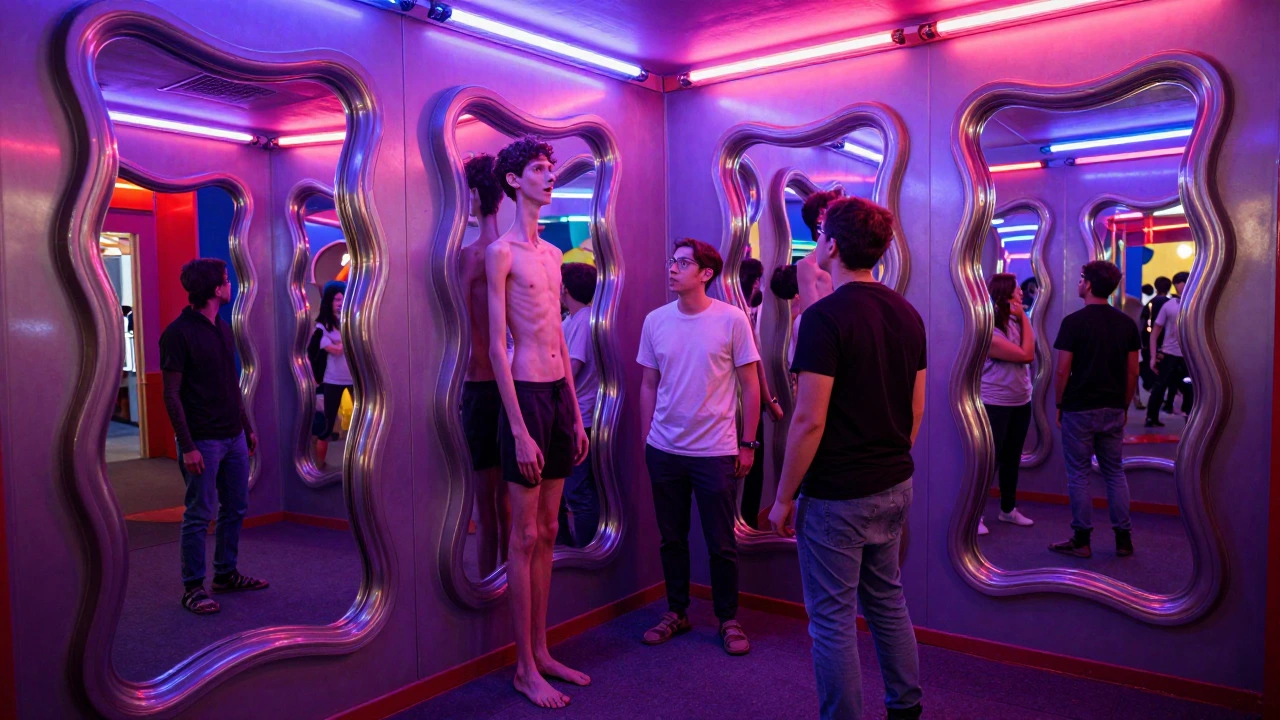
Have you ever walked into a carnival or a theme park and felt suddenly three feet tall, then instantly squashed flat against the floor? That disorienting, hilarious sensation is the work of a trick mirror, also known as distorted mirror or funhouse mirror. These aren't just polished glass with silver backing; they are carefully engineered optical devices designed to mess with your perception. While they seem like simple party tricks, they rely on complex principles of physics and geometry.
If you're curious about how these mirrors work, why they look so strange, or even if you want to build one yourself, you've come to the right place. We'll break down the science behind the distortion, explore the different types of curves used, and look at where you might find them beyond the circus tent.
The Physics Behind the Fun: How Distortion Works
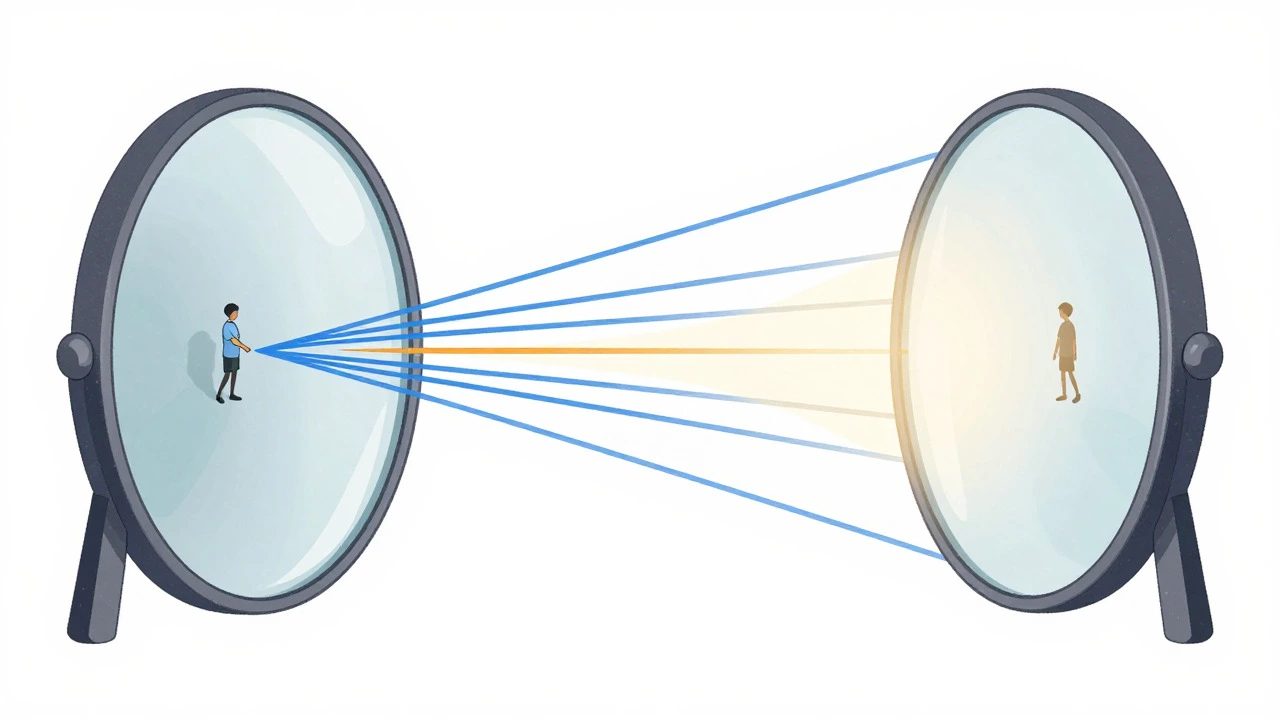
To understand what a trick mirror is, you first have to understand what a normal mirror does. A standard flat mirror reflects light rays at the same angle they hit it. This creates a virtual image that is the same size as the object and appears to be the same distance behind the glass as you are in front of it. It’s predictable and boring.
A trick mirror breaks this rule by using curved surfaces. When light hits a curved surface, the angle of reflection changes depending on exactly where the light ray strikes the curve. This causes the reflected rays to either converge (come together) or diverge (spread apart). Your brain expects light to travel in straight lines from the object to your eye, but the curved mirror bends that path. The result? Your brain constructs an image that is stretched, shrunk, twisted, or warped.
| Mirror Type | Shape Description | Visual Effect | Common Use |
|---|---|---|---|
| Convex Mirror | Bulges outward toward the viewer | Makes objects appear smaller and wider; provides a wider field of view | Security mirrors, blind corner mirrors, "wide-angle" vanity mirrors |
| Concave Mirror | Caves inward away from the viewer | Makes objects appear larger when close; can invert images if far away | Shaving mirrors, makeup mirrors, telescope components |
| Cylindrical Mirror | Curved in only one direction (like a tube cut lengthwise) | Stretches or compresses the image horizontally or vertically | Funhouses, art installations, decorative wall features |
| Spiral/Twisted Mirror | Combines multiple curves in a twisting pattern | Creates swirling, melting, or chaotic distortions | High-end amusement parks, psychological experiments |
Convex vs. Concave: The Two Main Players
Most trick mirrors are built using two basic shapes: convex and concave. You’ve probably seen both without realizing their technical names.
Convex mirrors bulge out toward you. Think of the back of a spoon. If you look at your reflection in the back of a spoon, you see a tiny, wide-eyed version of yourself. In a funhouse, a large convex mirror makes you look short and wide. Because they spread light out, they show more of the room but shrink everything in it. This is why security stores use them in corners-they let staff see a huge area, even if the customers look like little people.
Concave mirrors do the opposite. They cave inward, like the bowl of a spoon. Look into the bowl of a spoon, and your face looks huge and upside down if you hold it too far away. In a trick mirror setup, concave sections are often used to make you look tall and thin, or grotesquely enlarged. The distortion depends heavily on your distance from the mirror. Move closer, and the magnification increases dramatically. Move back, and the image flips. This variability is part of the fun-and the confusion.
Beyond the Funhouse: Where Else Do Trick Mirrors Appear?
While we associate distorted mirrors with carnivals and Halloween attractions, they serve serious purposes in other fields.
In optical engineering, concave mirrors are critical components in telescopes. The Hubble Space Telescope uses a massive concave primary mirror to gather light from distant stars. Unlike funhouse mirrors, these are ground to near-perfect precision to avoid distortion. But the principle is the same: controlling how light converges to form an image.
In automotive design, side-view mirrors on cars are often slightly convex. Have you noticed the warning label that says “Objects in mirror are closer than they appear”? That’s because the convex shape gives drivers a wider field of view, reducing blind spots. The trade-off is that cars look smaller and farther away than they really are. It’s a practical application of the same distortion that makes you look funny in a funhouse.
Even in art and installation design, artists use trick mirrors to create immersive experiences. Teams like TeamLab or Olafur Eliasson have created rooms filled with fragmented, angled, or curved mirrors to dissolve the boundary between the viewer and the environment. Here, the goal isn’t just humor-it’s to challenge how we perceive space and self.
Building Your Own Distorted Mirror: A DIY Guide
Want to try making your own trick mirror? It’s easier than you think, and you don’t need expensive equipment. You’ll need:
- A piece of glass or acrylic sheet (acrylic is safer for beginners)
- Reflective film or spray paint (silver reflective coating)
- A flexible backing material like foam board or plywood
- Tools to shape the backing: sandpaper, heat gun (for acrylic), or wood carving tools
Here’s how to do it:
- Choose your distortion type. Decide if you want to stretch, shrink, or twist the image. For a simple stretch, you’ll create a cylindrical curve. For a swirl, you’ll need a more complex spiral shape.
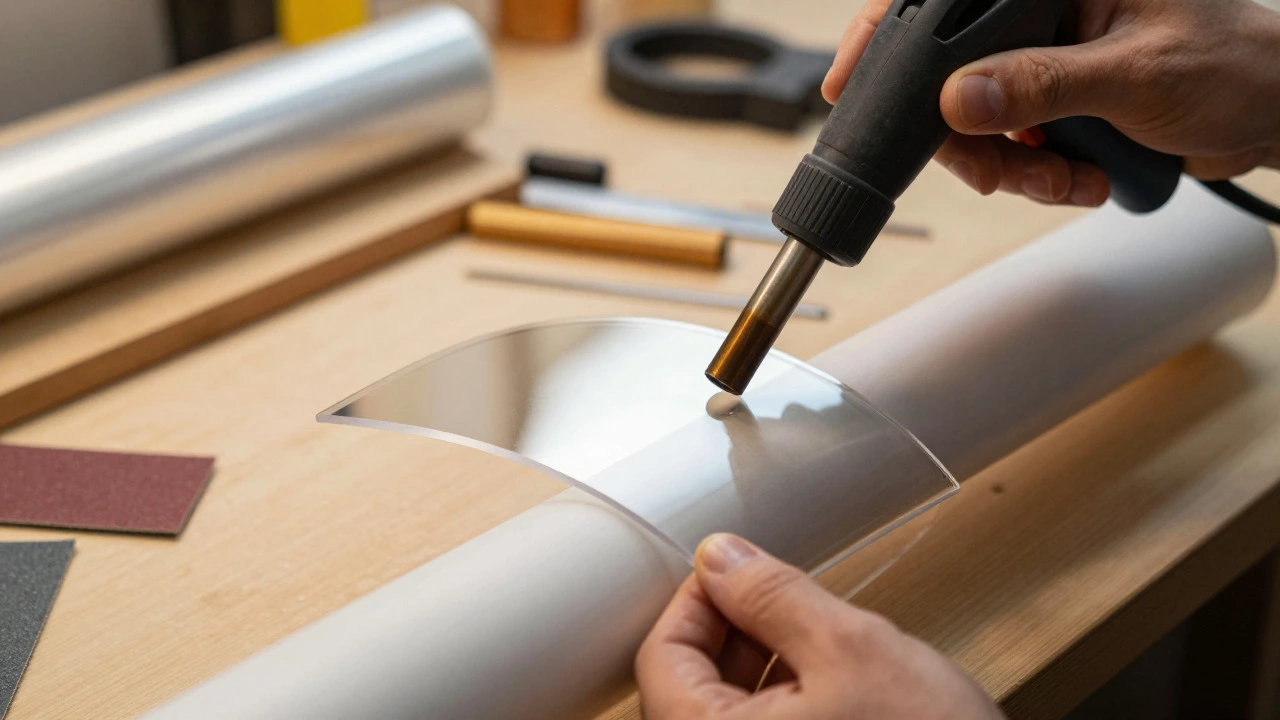
- Shape the backing. If using acrylic, heat it gently with a heat gun and bend it over a rounded object (like a pipe or cylinder) to create a curve. Let it cool in place. If using wood, carve the desired shape. Remember: the curve must be smooth. Bumps will create ugly, random distortions.
- Apply the reflective surface. Stick reflective film onto the front of the acrylic, or spray-paint the shaped backing with silver reflective paint. Make sure there are no bubbles or scratches.
- Mount and test. Attach the mirror to a frame or stand. Step back and check the reflection. Adjust the curve if needed-small changes in curvature can drastically alter the effect.
Safety note: Always wear gloves and eye protection when handling glass or hot acrylic. And never leave children unsupervised around homemade mirrors-edges can be sharp.
Why Do We Love Distorted Reflections?
There’s something deeply satisfying about seeing ourselves transformed. Psychologists suggest that trick mirrors tap into our curiosity about identity and perception. When your reflection doesn’t match your internal sense of self, it creates a momentary cognitive dissonance-a mild surprise that triggers laughter or fascination.
Children especially love trick mirrors because they’re still developing their body image and spatial awareness. Seeing themselves as giants or dwarfs helps them understand that perspective is relative. Adults enjoy them for nostalgia and humor, but also because they offer a rare chance to step outside the rigid norms of everyday appearance.
In a world where social media filters already distort our images digitally, physical trick mirrors feel refreshingly analog. There’s no algorithm deciding how you should look-just pure, unfiltered physics playing tricks on your eyes.
Troubleshooting Common Issues
If you’re building or buying a trick mirror and the distortion isn’t working as expected, here are some common fixes:
- Image is blurry: Check for dust, fingerprints, or uneven coating on the reflective surface. Clean gently with microfiber cloth.
- No distortion: The curve may be too subtle. Increase the radius of curvature or combine multiple curves.
- Unwanted warping: Ensure the backing material is rigid enough to hold its shape. Flexible materials can sag over time.
- Image flips unexpectedly: This happens with concave mirrors when you move beyond the focal point. Stay within the intended viewing distance.
Are trick mirrors dangerous?
Generally, no. Commercial trick mirrors are made with safety glass or shatterproof acrylic. Homemade versions should use acrylic instead of glass to reduce injury risk. Avoid looking into strong concave mirrors for extended periods, as the intense magnification can cause eye strain.
Can you use a trick mirror for photography?
Yes! Many photographers use distorted mirrors creatively to produce surreal, abstract portraits. Position your subject in front of the mirror and shoot the reflection. Experiment with angles and lighting to enhance the distortion effect.
Why do funhouse mirrors make some people look taller and others shorter?
It depends on which part of the mirror you’re standing in front of. Vertical stretches come from concave curves running top-to-bottom. Horizontal squeezes come from convex curves side-to-side. Most funhouse mirrors combine both, so your position determines whether you’re elongated or compressed.
Do trick mirrors work with video calls?
Not directly. Video cameras capture real-time light, not reflections. To use a trick mirror in a video call, you’d need to position the mirror so your camera films the reflection rather than your face directly. This requires careful setup and good lighting.
Where can I buy high-quality trick mirrors?
Specialty retailers like Carnival Supply Co., Funhouse Attractions, or online marketplaces like Etsy offer pre-made distorted mirrors. For custom designs, search for “custom curved mirror makers” or contact local glass artisans who specialize in decorative mirrors.