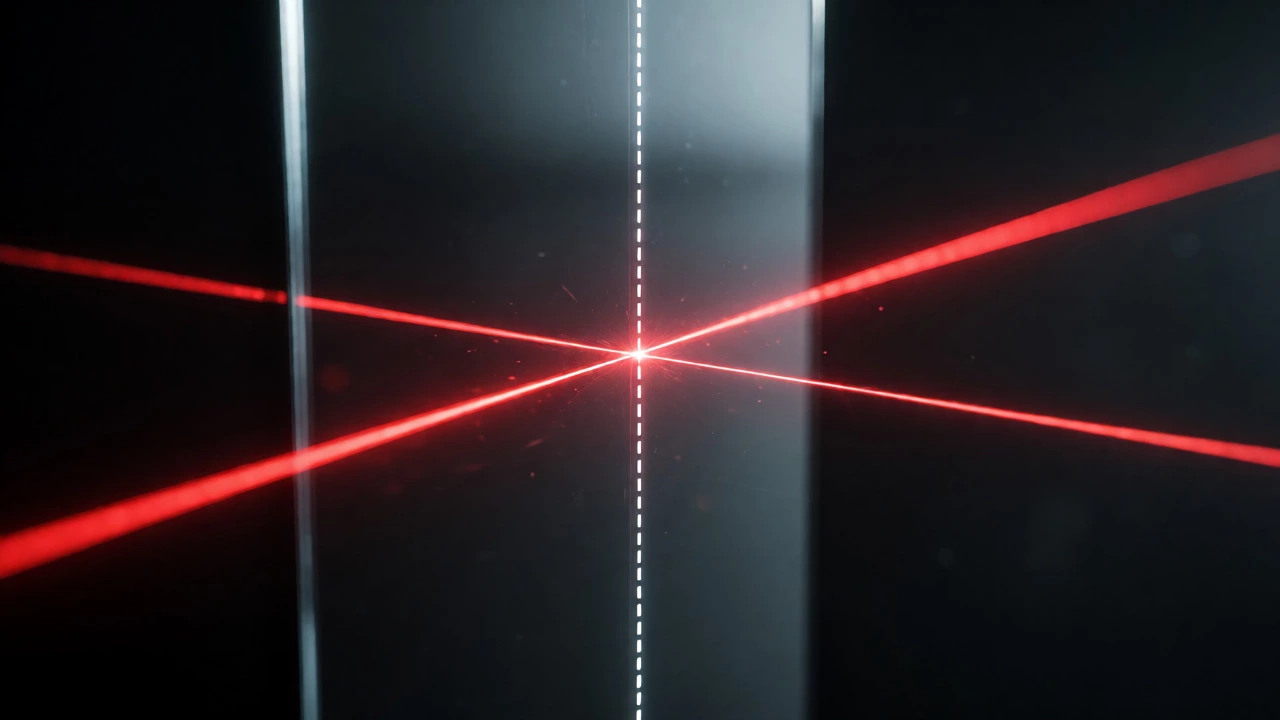
Interactive Mirror Reflection Simulator
Adjust the slider to change the angle at which light hits the mirror. Observe how the reflected ray changes according to the laws of reflection.
Law 2: The incident ray, reflected ray, and normal all lie in the same plane.
Observations:
- Incident Ray Angle: 30°
- Reflected Ray Angle: 30°
- Status: Equal ✓
You’ve probably stood in front of a bathroom mirror a thousand times. You wave, it waves back. You raise your left hand, and the person in the glass raises what looks like their right. It feels like magic, or maybe just basic common sense. But there is actually a strict set of rules governing exactly how light bounces off that smooth surface. If you’ve ever wondered why you can see yourself clearly but not through a brick wall, or why a periscope works, it all comes down to two simple scientific principles.
These are known as the laws of mirror reflection. They aren’t complicated math equations that require a PhD to solve. In fact, they are so straightforward that once you understand them, you’ll start seeing them everywhere-in car side mirrors, in the shimmering surface of a lake, and even in the way sunlight hits your kitchen floor. Let’s break down exactly what these two laws are, why they matter, and how they shape the world we see around us.
The Core Concept: What Is Reflection?
Before we get into the specific laws, we need to agree on what is happening when you look in a mirror. Light travels from a source (like the sun or a bulb), hits an object (your face), and bounces off that object. Some of that bounced light hits the mirror. The mirror doesn’t absorb the light; it sends it back. This bouncing back of light is called reflection, which is the change in direction of a wavefront at an interface between two different media so that the wavefront returns into the medium from which it originated.
Mirrors are special because they have a very smooth surface. When light hits a rough surface, like paper or a concrete wall, it scatters in all directions. That’s diffuse reflection. But when light hits a smooth surface like a mirror, it reflects in a single, organized direction. That’s specular reflection. And this organized bounce is where the laws come in.
Law One: The Angle Rule
The first law is the one most people remember from school science class, often summarized by the phrase "angle in equals angle out." Technically, it states that the angle of incidence is equal to the angle of reflection.
But wait-what do we mean by "angle"? This is where things get tricky if you don’t visualize it correctly. You might think the angle is measured against the surface of the mirror itself. It isn’t. In optics, we measure angles relative to an imaginary line called the normal, which is an imaginary line perpendicular (at 90 degrees) to the surface of the mirror at the point where the light ray strikes.
- Angle of Incidence: The angle between the incoming light ray and the normal line.
- Angle of Reflection: The angle between the outgoing reflected ray and the normal line.
If a laser beam hits a mirror at 30 degrees from the normal, it will bounce off at exactly 30 degrees from the normal on the other side. It never deviates. This predictability is what allows engineers to design telescopes, periscopes, and fiber optic cables. If light scattered randomly every time it hit glass, our technology would be a mess.
Law Two: The Plane Rule
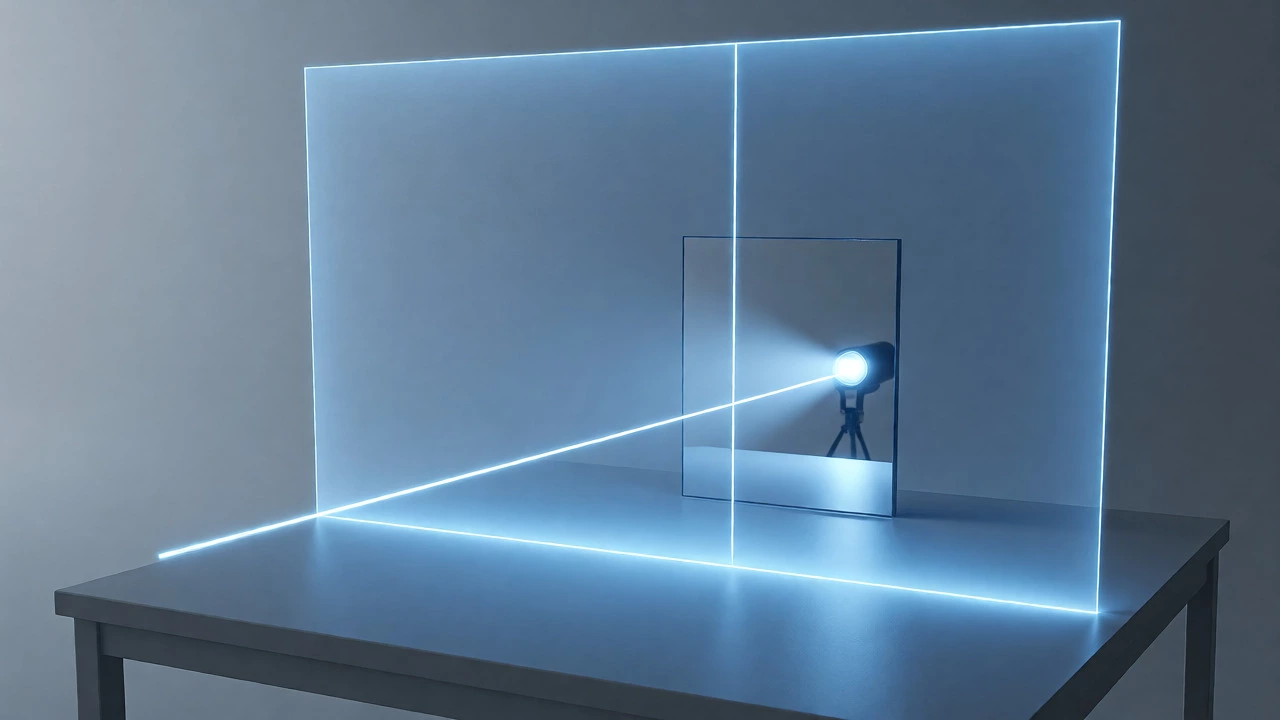
The second law is less about numbers and more about geometry. It states that the incident ray, the reflected ray, and the normal to the surface all lie in the same plane.
This sounds abstract, but try this experiment. Take a piece of paper and draw a line across the middle. Stand the paper up vertically. Shine a flashlight at the paper from the left side. The light hits the paper and bounces back. Now, tilt the paper forward or backward. Does the light still bounce straight back toward you? No. It bounces up or down.
Why? Because the "plane" changed. The first law tells you how much the light turns. The second law tells you which way it turns. It ensures that light doesn’t twist sideways unexpectedly. If you shine a light at a mirror from directly above, the reflection goes straight back up. It won’t suddenly veer to the left or right unless the mirror itself is tilted sideways. This rule keeps reflections stable and predictable, preventing weird distortions in standard flat mirrors.
Real-World Application: Why Mirrors Reverse Left and Right
A common confusion with the laws of reflection is the idea that mirrors flip images left-to-right. They don’t, strictly speaking. Mirrors reverse front-to-back. Think about it: if you wear a hat with a logo on the front, the mirror shows the logo facing away from you. The part of your body closest to the mirror (your nose) appears closest in the reflection. The part farthest away (the back of your head) appears farthest.
So why does it feel like a left-right swap? It’s a psychological trick. When you imagine someone turning around to face you, you mentally rotate yourself 180 degrees around a vertical axis. Your left hand becomes your right hand in that mental model. But the mirror didn’t rotate you; it projected you straight back. Understanding the laws helps clear up this illusion. The light rays obey the angle rules perfectly; our brains just interpret the result incorrectly based on social cues.
Curved Surfaces: Concave and Convex Mirrors
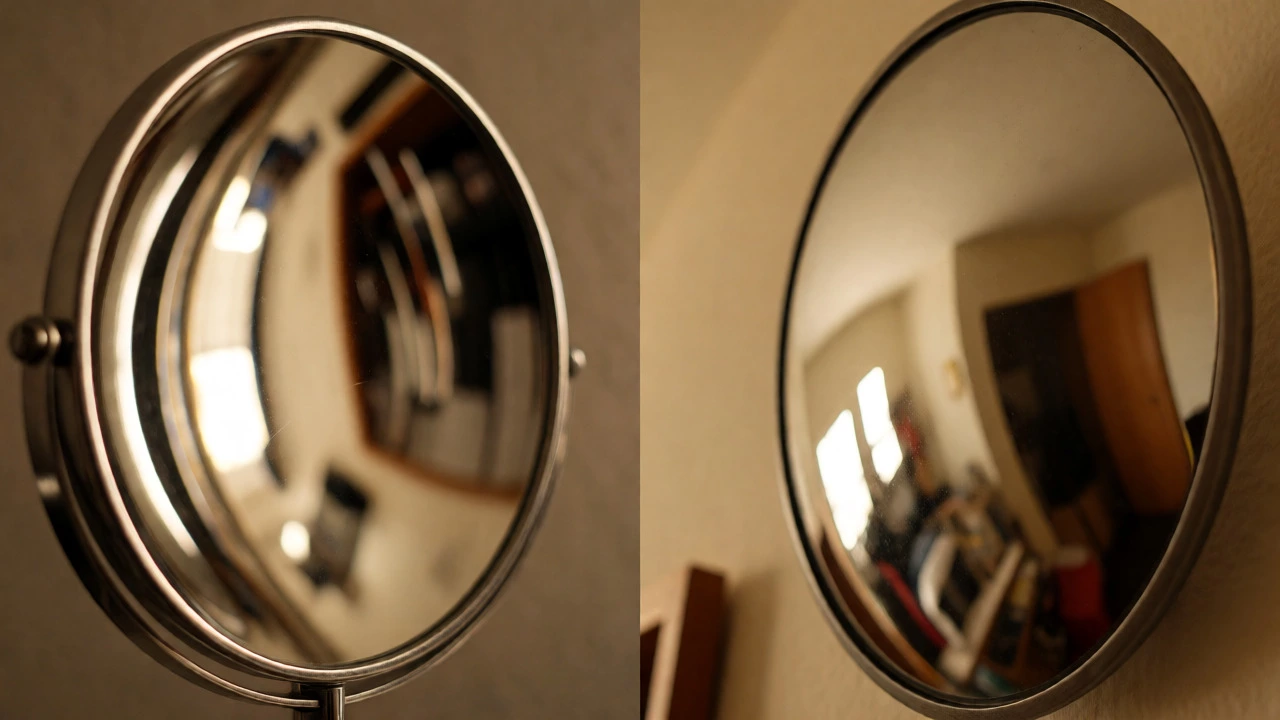
Do the two laws still apply if the mirror isn’t flat? Absolutely. The laws of reflection are universal for specular surfaces. However, applying them to curved surfaces requires a bit more work because the "normal" line changes at every single point on the curve.
| Mirror Type | Surface Shape | Image Characteristics | Common Use |
|---|---|---|---|
| Plane Mirror | Flat | Virtual, upright, same size | Bathrooms, dressing rooms |
| Concave Mirror | Inward curve (like a cave) | Can be magnified or inverted depending on distance | Shaving mirrors, telescopes |
| Convex Mirror | Outward curve (bulging) | Always virtual, upright, smaller (wider field of view) | Car side mirrors, security mirrors |
For a concave mirror, the normal lines converge toward a focal point. This causes light rays to gather together, which is why you can focus sunlight to burn paper using a parabolic dish. For a convex mirror, the normals diverge, spreading light out. This gives drivers a wider view of the road behind them, which is why those mirrors say "Objects in mirror are closer than they appear." The laws haven’t changed; the geometry of the surface has.
How to Test These Laws at Home
You don’t need a lab to prove this stuff. Grab a small handheld mirror, a sheet of graph paper, and a flashlight. Here is a quick way to verify the first law:
- Lay the graph paper flat on a table.
- Place the mirror upright along one of the grid lines.
- Draw a line representing the normal (perpendicular to the mirror).
- Shine the flashlight at the mirror from an angle, tracing the path of the light on the paper.
- Trace the path of the reflected light.
- Measure the angles with a protractor.
You should find that the angle of incidence matches the angle of reflection within a degree or two. Small errors usually come from the thickness of the glass or the width of the flashlight beam. But the principle holds firm. This simple experiment demonstrates why optical instruments are reliable. Engineers rely on this consistency to build everything from camera lenses to solar power plants.
Why This Matters Beyond Physics Class
You might ask, "Ember, I’m buying curtains, not building a telescope. Why care?" Well, understanding reflection helps you make better choices in home decor and safety. Have you ever tried to watch TV during the day and struggled with glare? That’s uncontrolled specular reflection. Knowing the angle of incidence helps you position lamps or adjust blinds to direct light away from the screen.
It also explains why some mirrors look distorted. If you buy a cheap "decorative" mirror with slight waviness, the normal line varies wildly across the surface. Light bounces in inconsistent directions, creating funhouse-style warping. High-quality mirrors maintain a precise flatness to ensure the laws of reflection produce a true image.
Do the laws of reflection apply to water?
Yes, calm water acts like a mirror. The laws of reflection apply exactly the same way. However, if the water is choppy, the surface becomes rough, leading to diffuse reflection where the image breaks apart rather than forming a clear picture.
Why do mirrors reverse left and right but not top and bottom?
Mirrors actually reverse front and back. The left-right reversal is a psychological effect caused by how we perceive rotation. We imagine ourselves turning around to face the mirror, which swaps our left and right hands. Top and bottom remain consistent because gravity defines our orientation, and we don't mentally flip upside down.
What happens if light hits a mirror at 0 degrees?
If light hits the mirror straight on (along the normal), the angle of incidence is 0 degrees. According to the first law, the angle of reflection is also 0 degrees. This means the light bounces directly back along the same path it came from.
Can the laws of reflection be broken?
In standard classical physics, no. Specular reflection always obeys these laws. However, in quantum mechanics or with metamaterials engineered at the nanoscale, scientists can manipulate light in ways that seem to defy traditional geometric optics, but for everyday objects, the laws hold true.
Does the color of the mirror affect the laws?
No. The laws of reflection depend on the geometry of the surface, not its color. A red mirror absorbs some wavelengths and reflects others, but the angle at which the reflected light leaves the surface still follows the angle of incidence rule.