Mirror Physics Simulator
Mirror Settings
What's Happening?
A flat mirror shows your true size regardless of distance. The reflection maintains a 1:1 ratio with reality.
Have you ever stepped up to a makeup mirror and suddenly felt like your pores were the size of dinner plates? Or maybe you’ve looked into a hallway mirror that made you feel unnaturally thin? It’s not just your imagination. The shape of the glass is actively manipulating how light reflects off your body, changing the size and proportion of your reflection in real-time.
If you are wondering what type of mirror makes you look larger, the short answer is a concave mirror. But the physics behind it-and why most household mirrors don’t do this-is worth understanding if you want to choose the right glass for your vanity, your gym, or your bedroom.
The Physics of Reflection: Why Shape Matters
To understand why one mirror expands your image while another shrinks it, we have to look at curvature. Most people assume all mirrors are flat sheets of glass with silvering on the back. While true for standard wall decor, specialized mirrors use curved surfaces to bend light rays differently.
Light travels in straight lines until it hits a surface. When it hits a mirror, it bounces off. The angle at which it bounces depends entirely on the shape of that surface. This is basic optics, but it has massive implications for how we perceive ourselves.
- Flat (Plane) Mirrors: These reflect light at the same angle it arrives. Your reflection is the exact same size as you are, provided you stand at a normal distance. This is the gold standard for accurate self-perception.
- Concave Mirrors: These curve inward, like the inside of a spoon. They converge light rays. Depending on your distance from the glass, they can magnify your image significantly.
- Convex Mirrors: These curve outward, like the back of a spoon. They diverge light rays, spreading them out. This creates a wider field of view but shrinks the objects within it.
When you ask what makes you look larger, you are looking for convergence. You need the mirror to gather light from a small area of your face and project it onto a larger area of your retina. That is the job of the concave surface.
How Concave Mirrors Create Magnification
A concave mirror acts as a magnifier when you stand close to it. Think about the makeup mirrors you see in drugstores or high-end beauty counters. Many of these are double-sided: one side is flat, and the other is concave, often labeled "5x" or "10x" magnification.
Here is how the magic happens. Because the surface curves inward toward you, the center of the mirror is closer to your face than the edges. Light rays reflecting from your nose hit the center and bounce back at a steeper angle than rays hitting your cheeks. This distortion stretches the image horizontally and vertically.
However, there is a catch. Concave mirrors have a focal point. If you stand too far away-past that focal point-the image flips upside down and becomes smaller. To get the enlargement effect, you must stay within the focal length. For a typical bathroom magnifying mirror, this means standing just a few inches away. Step back three feet, and the magnification vanishes, replaced by a distorted, tiny, inverted version of yourself.
| Mirror Type | Curvature Direction | Visual Effect | Common Use Case |
|---|---|---|---|
| Plane (Flat) | None | Accurate size and proportion | Bathroom walls, dressing rooms |
| Concave | Inward (toward viewer) | Magnifies when close; inverts when far | Makeup application, dentistry, telescopes |
| Convex | Outward (away from viewer) | Minifies; widens field of view | Security corners, car side mirrors, hallways |
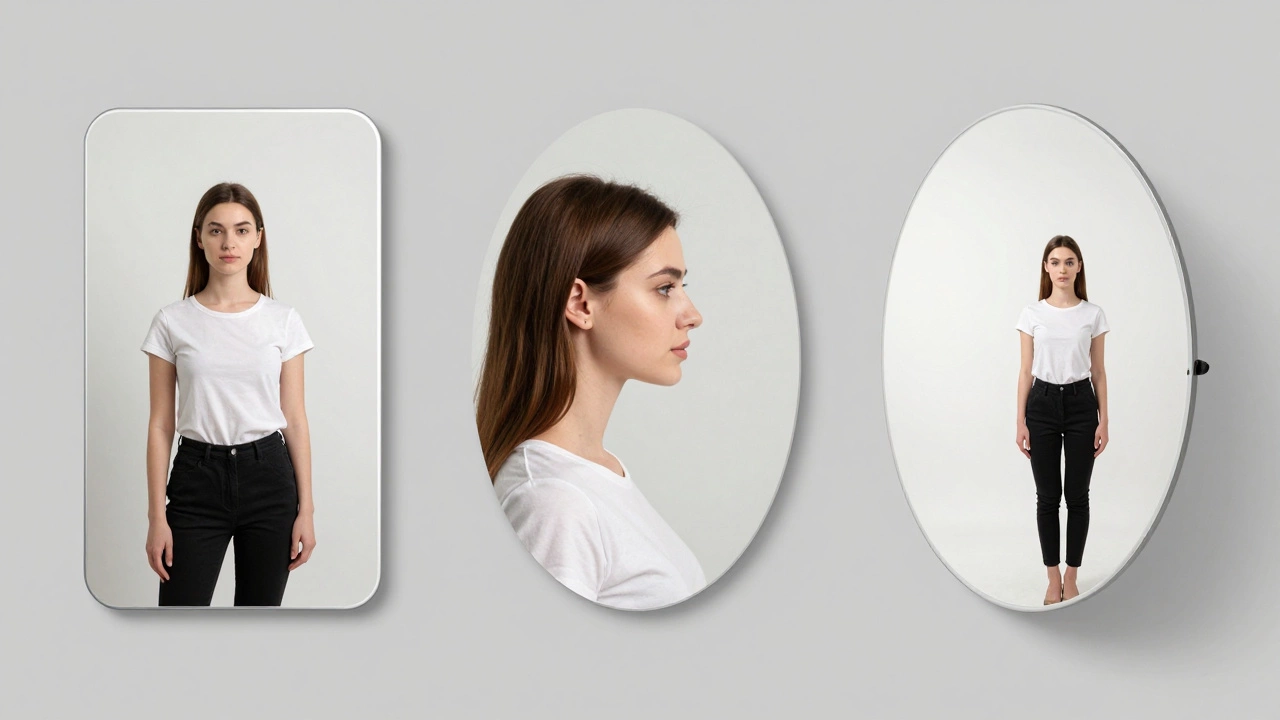
The Convex Trap: Why Some Mirrors Make You Look Smaller
If concave mirrors make you look bigger, convex mirrors make you look smaller. You have likely encountered these without realizing it. Look at the passenger-side mirror on your car. It probably says, "Objects in mirror are closer than they appear." That warning exists because the convex shape compresses the world behind you into a tiny, wide-angle snapshot.
In home decor, convex mirrors are sometimes used in narrow hallways or small entryways to create an illusion of space. By shrinking the reflection, they make the room feel less cluttered and more open. But if you stand in front of one, you will look thinner and shorter. This is generally not the desired effect for a vanity mirror, though some fitness enthusiasts might appreciate the slimming feedback during workouts.
It is crucial to distinguish between intentional optical design and manufacturing defects. Sometimes, a mirror looks convex or concave simply because it was installed poorly or the glass itself is warped. A cheap, large mirror mounted on uneven drywall might bulge slightly in the middle. This unintentional curvature can distort your proportions, making your waist look wider or your legs look shorter. This is known as a "funhouse" effect, and it is usually a sign of low-quality installation rather than deliberate design.
Why Flat Mirrors Are the Standard for Daily Life
If concave mirrors offer magnification, why don’t we put them everywhere? The answer lies in accuracy. For daily tasks like getting dressed, checking your hair, or applying sunscreen, you need to know what you actually look like. A magnified image hides imperfections and distorts proportions. Makeup applied under a 10x concave mirror often looks heavy and cakey when viewed in a flat mirror later.
Flat mirrors provide a 1:1 ratio. One inch on your face equals one inch in the reflection. This consistency builds muscle memory for grooming tasks. It also provides psychological stability. Seeing a distorted version of yourself repeatedly can affect body image. Studies in environmental psychology suggest that consistent visual feedback helps maintain a stable sense of self. Warped or highly magnified mirrors can introduce subtle cognitive dissonance over time.
Furthermore, flat mirrors are easier to manufacture and install. Large sheets of perfectly flat glass require precise tempering and mounting. Curved mirrors require complex molding processes. This is why your full-length closet mirror is almost certainly plane, while only your small, handheld cosmetic mirror is concave.

Choosing the Right Mirror for Your Needs
Selecting a mirror depends on the "job" you need it to do. Here is a breakdown of scenarios where specific mirror types shine:
- Detailed Grooming: Use a dual-sided mirror with a concave side (5x-10x magnification). Keep it close to your face. Use LED lighting around the frame to eliminate shadows, which compound distortion.
- General Appearance Check: Stick to a high-quality flat mirror. Ensure it is at least 36 inches wide to capture your full upper body. Mount it so the top edge is level with your eyes.
- Small Space Expansion: In tight corridors, a convex mirror can help you see around corners and make the space feel airier, though it won’t be useful for checking your outfit.
- Fitness Tracking: Some gyms use slightly convex mirrors to allow users to see their entire form from a distance. However, for posture correction, a flat mirror is superior because it shows true alignment.
When buying a magnifying mirror, pay attention to the diameter. A larger concave surface allows for a more natural viewing angle. Small concave mirrors force you to contort your neck to find the sweet spot of magnification. Look for brands that specify the focal length or magnification power clearly. Avoid unmarked "beauty" mirrors, as they may have inconsistent curvature that causes eye strain.
Troubleshooting Distorted Reflections
Sometimes, you buy a mirror expecting it to be flat, but it behaves like a funhouse attraction. How do you tell if your mirror is genuinely curved or just poorly installed?
Perform the "straightedge test." Place a ruler or a level against the surface of the mirror. If light shines through the gap between the ruler and the glass, the mirror is warped. Alternatively, look at a doorframe or window grid reflected in the mirror. Straight lines should remain straight. If vertical lines bow inward or outward, the glass is concave or convex, respectively.
If your new mirror distorts your image, check the mounting hardware. Large mirrors flex if they are not supported evenly across the back. Using adhesive strips instead of nails can sometimes cause the glass to bow if the wall surface is uneven. Re-mounting with proper brackets or ensuring the wall is plumb can often restore accuracy.
Remember, the goal of a mirror is to serve you. Whether you need the scrutiny of a concave lens for skincare or the honest truth of a flat pane for your morning routine, understanding the geometry behind the glass empowers you to choose wisely. Don’t let a bad reflection fool you into thinking you’ve changed overnight. It’s just physics.
Does a concave mirror always make you look larger?
No. A concave mirror only magnifies your image if you stand closer to it than its focal point. If you stand further away than the focal length, the image will appear smaller and upside down. For typical bathroom mirrors, this means staying within 6-12 inches of the glass to see magnification.
Why do some bathroom mirrors make me look fatter?
This is usually caused by a slight concave curvature in the glass, either intentional or due to poor manufacturing/installation. Concave mirrors converge light, stretching the image horizontally and vertically. Additionally, poor lighting can cast shadows that accentuate contours, creating an illusion of added weight.
What is the difference between a convex and concave mirror?
A concave mirror curves inward (like a cave), causing light rays to converge. This can magnify images when viewed up close. A convex mirror curves outward (like a hill), causing light rays to diverge. This shrinks images and provides a wider field of view, commonly seen in security mirrors and car side-view mirrors.
Are magnifying mirrors good for applying makeup?
Yes, but with caution. Concave magnifying mirrors (5x-10x) are excellent for detailed work like eyeliner or tweezing. However, because they exaggerate features, it is easy to apply too much product. It is best to use them for precision tasks and step back to a flat mirror to check the overall balance before finishing.
How can I tell if my mirror is warped?
Look at a straight line in the reflection, such as a doorframe or window sill. If the line appears bent or bowed, the mirror is warped. You can also place a straightedge against the glass; if light passes through the gap, the surface is not flat. Poorly mounted large mirrors often warp due to uneven pressure on the backing.