Triangle Bathroom Space Calculator
Your Bathroom Space Analysis
Enter your bathroom's dimensions to see if it's suitable for a triangle layout design.
Space Assessment
Recommended Layout
Flush against narrowest corner
Adjacent wall, under 30cm depth
Along longest side, walk-in only
Key Considerations
Ever walked into a bathroom that felt oddly shaped-like it was squeezed into a corner-and wondered why it looked so different from the usual rectangle? That’s probably a triangle bathroom. It’s not a style of tile or a fancy fixture. It’s a layout. A triangle bathroom uses the shape of the room itself-often a narrow, wedge-shaped space-to fit a toilet, sink, and shower into the smallest possible footprint. And in today’s world where homes are getting smaller and urban living is rising, this design isn’t just clever-it’s becoming common.
Why Do Triangle Bathrooms Exist?
They’re born out of necessity. Think of old houses in cities like Wellington, Sydney, or London, where builders had to squeeze every last inch out of a plot. Maybe the house was built on a sloping lot, or a staircase cut into the back corner. Maybe it was a renovation that left only a sliver of space. Instead of giving up and calling it unusable, designers turned that awkward triangle into a functional bathroom.
It’s not about aesthetics first. It’s about solving a problem: how do you fit a bathroom where there’s barely enough room to turn around? The answer? Use the walls. Use the angles. Let the shape of the room dictate the layout.
How a Triangle Bathroom Works
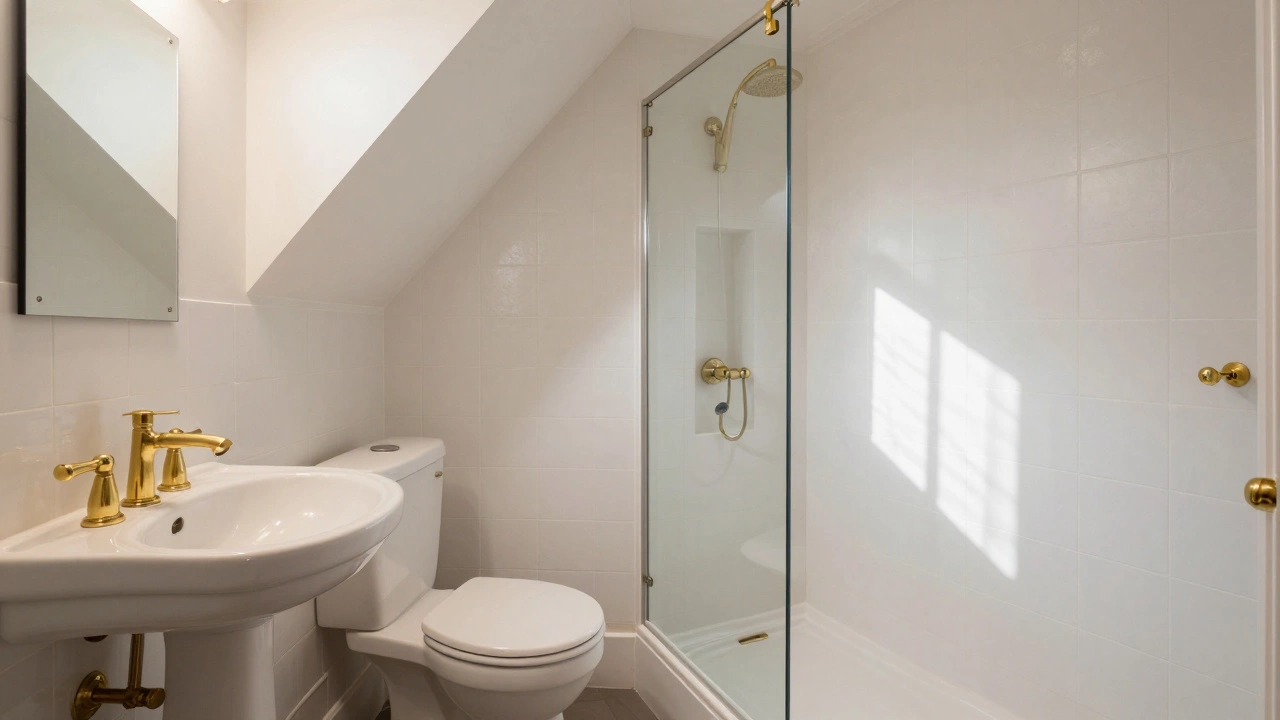
A typical triangle bathroom has three key elements: a toilet, a sink, and a shower or tub. The trick is arranging them along the three sides of the triangle. One wall holds the toilet. The longest wall-usually the one opposite the corner-holds the shower. The sink fits into the remaining corner, often tucked right next to the shower or toilet.
Here’s how it usually breaks down:
- Corner toilet: Mounted flush against two walls in the narrowest point of the triangle. This saves space and keeps the flow clear.
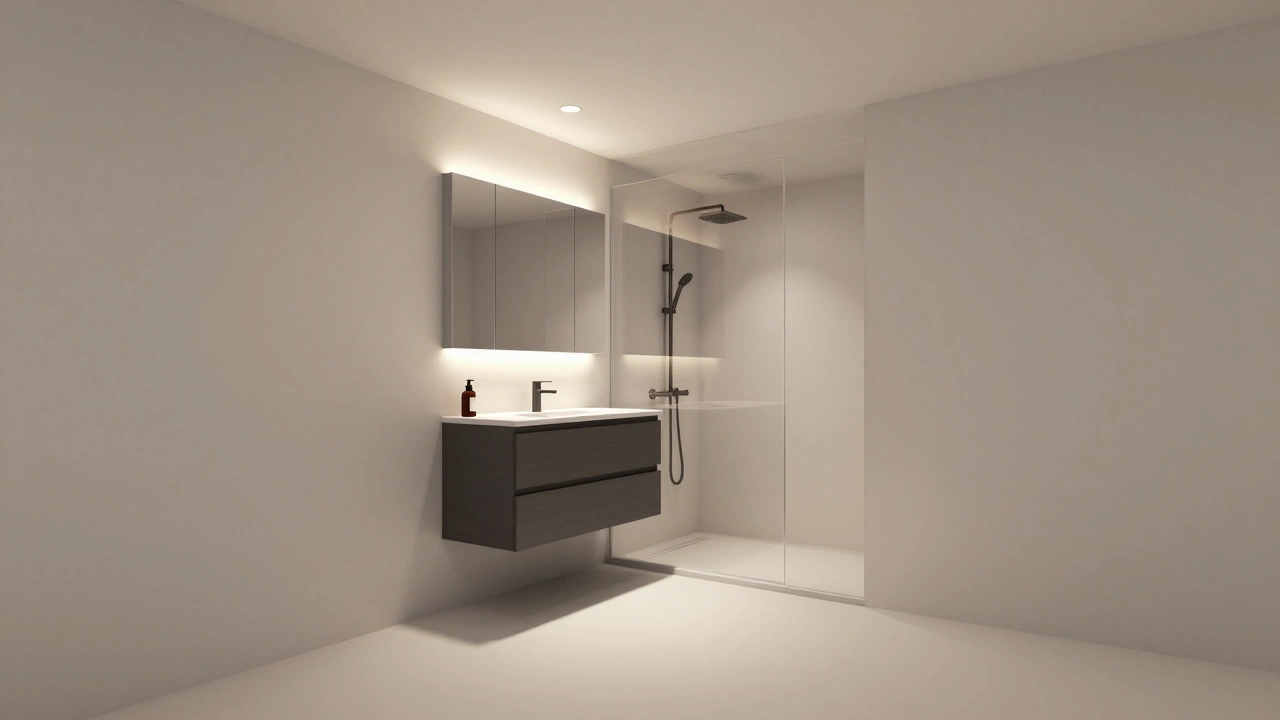
- Wall-mounted sink: Mounted on the adjacent wall, often with a shallow basin to avoid blocking movement. Some use floating vanities to keep the floor visible and feel less cramped.
- Shower in the long wall: A walk-in shower with a glass panel or curtain runs the length of the longest side. No tub-too bulky. A niche in the wall holds shampoo and soap.
There’s no standard size, but most triangle bathrooms are under 5 square meters. Some are as small as 2.5 square meters. That’s smaller than a parking spot. And yet, they work.
What Makes Them Different From Regular Bathrooms?
Regular bathrooms are boxy. They have straight walls, predictable corners, and room to move. Triangle bathrooms are the opposite. They’re tight. They’re angled. They force you to think differently about how you use space.
For example:
- You don’t open a cabinet door fully-it hits the shower.
- You step sideways to get from the sink to the toilet.
- There’s no room for a towel rack on the back of the door. You mount it on the wall beside the shower.
It’s not about luxury. It’s about efficiency. Every inch has to pull its weight. That’s why you see things like recessed shelves, mirrored cabinets that double as storage, and faucets with built-in soap dispensers. There’s no room for extras.
Who Benefits From a Triangle Bathroom?
Not everyone needs one. But if you fall into any of these groups, it might be the smartest choice you make:
- City dwellers: Apartments in Auckland, Melbourne, or Berlin often have odd-shaped rooms left over from older construction. A triangle bathroom turns wasted space into usable space.
- Home renovators: If you’re adding a bathroom to a loft, attic, or basement with irregular walls, a triangle layout avoids costly structural changes.
- Small home owners: Tiny houses, studio apartments, or ADUs (accessory dwelling units) often rely on this design to meet code without sacrificing function.
- Travelers and Airbnb hosts: A compact, efficient bathroom in a guest suite can make a big impression-especially if it’s clean, well-lit, and has good storage.
It’s not about saving money on materials. It’s about saving space-and space, in dense urban areas, is worth more than gold.
Common Mistakes People Make
Triangle bathrooms look simple. But they’re easy to mess up. Here’s what goes wrong:
- Choosing the wrong sink: A deep, wide basin might look nice, but it’ll block the path to the toilet. Stick to narrow, wall-mounted sinks with a depth under 30 cm.
- Ignoring lighting: With walls at odd angles, shadows form in corners. A single ceiling light won’t cut it. Add LED strips under the vanity or a wall sconce near the mirror.
- Forgetting ventilation: Moisture gets trapped in tight spaces. A window isn’t always an option. Install a quiet, high-CFM exhaust fan-preferably one with a humidity sensor.
- Overloading with storage: You’re tempted to add shelves everywhere. But too many shelves make the room feel cluttered. Go for two or three smart storage spots: a mirrored cabinet, a recessed niche, and a towel hook.
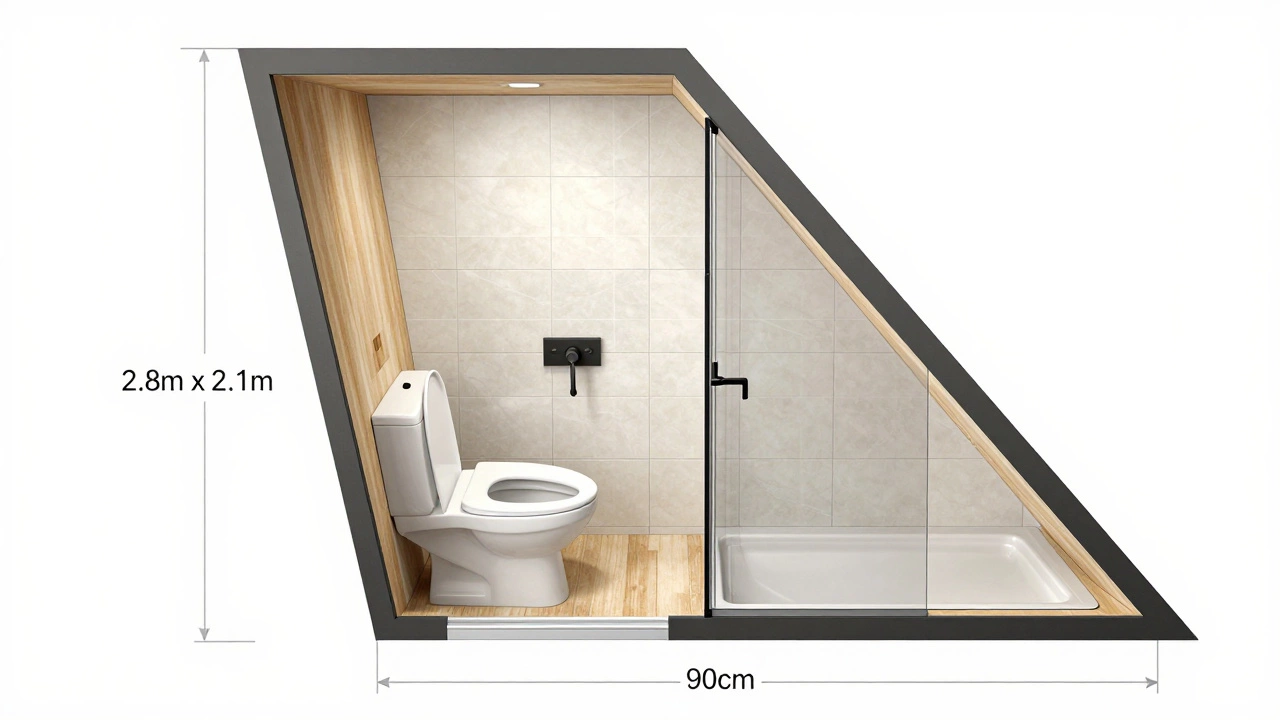
One real-life example: A couple in Wellington turned a 2.8m x 2.1m triangular closet into a bathroom. They used a corner toilet, a 45cm-wide sink, and a 90cm-wide shower with a sliding door. The total cost? Under $4,500 NZD. No permits needed. They used leftover tiles from their kitchen renovation. Now, it’s the most-used bathroom in the house.
Is a Triangle Bathroom Right for You?
Ask yourself these questions:
- Is your space oddly shaped, and can’t you move walls?
- Do you need a bathroom but don’t have room for a full-size one?
- Are you okay with a tighter, more compact layout?
- Can you live without a bathtub?
If you answered yes to most of those, then yes-it’s worth considering. Triangle bathrooms aren’t for everyone. But for the right person, they’re the only solution that makes sense.
They’re not glamorous. They don’t show up in magazine spreads. But they’re practical. They’re smart. And in a world where space is shrinking, they’re becoming more common than you think.
What Comes Next?
If you’re thinking about building or remodeling one, start by measuring your space. Sketch the triangle. Mark where the plumbing is. Then look at pre-fabricated corner shower units and wall-mounted toilets-they’re designed for exactly this. Companies like Kohler, Geberit, and even IKEA offer compact solutions that fit these layouts.
Don’t try to force a standard bathroom into a triangle shape. Work with the shape. Let it guide you. The best triangle bathrooms don’t fight their form-they celebrate it.